
Porting systemd to musl libc-powered Linux

I have completed an initial new port of systemd to musl. This patch set does not share much in common with the existing OpenEmbedded patchset. I wanted to make a fully updated patch series targeting more current releases of systemd and musl, taking advantage of the latest features and updates in both. I also took a focus on writing patches that could be sent for consideration of inclusion upstream.

The final result is a system that appears to be surprisingly reliable considering the newness of the port, and very fast to boot.

Why?

I have wanted to do this work for almost a decade. In fact, a mention of multiple service manager options – including systemd – is present on the original Adélie Web site from 2015. Other initiatives have always taken priority, until someone contacted us at Wilcox Technologies Inc. (WTI) interested in paying on a contract basis to see this effort completed.

I want to be clear that I did not do this for money. I believe strongly that there is genuine value in having multiple service managers available. User freedom and user choice matter. There are cases where this support would have been useful to me and to many others in the community. I am excited to see this work nearing public release and honoured to be a part of creating more choice in the Linux world.

How?

I started with the latest release tag, v256.5. I wanted a version closely aligned to upstream’s current progress, yet not too far away from the present “stable” 255 release. I also wanted to make sure that the fallout from upstream’s removal of split-/usr support would be felt to its maximum, since reverting that decision is a high priority.

I fixed build errors as they happened until I finally had a built systemd. During this phase, I consulted the original OE patchset twice: once for usage of GLOB_BRACE, and the other for usage of malloc_info and malloc_trim. Otherwise, the patchset was authored entirely originally, mostly through the day (and into the night) of August 16th, 2024.

Many of the issues seen were related to inclusion of headers, and I am already working on bringing those fixes upstream. It was then time to run the test suite.

Tests!

The test suite started with 27 failures. Most of them were simple fixes, but one that gave me a lot of trouble was the time-util test. The strptime implementation in musl does not support the %z format specifier (for time zones), which the systemd test relies on. I could have disabled those tests, but I felt like this would be taking away a lot of functionality. I considered things like important journals from other systems – they would likely have timestamps with %z formats. I wrote a %z translation for systemd and saw the tests passing.

Other test failures were simple C portability fixes, which are also in the process of being sent upstream.

The test suite for systemd-sysusers was the next sticky one. It really exercises the POSIX library functions getgrent and getpwent. The musl implementations of these are fine, but they don’t cope well with the old NIS compatibility shims from the glibc world. They also can’t handle “incomplete” lines. The fix for incomplete line handling is pending, so in the meantime I made the test have no incomplete lines. I added a shim for the NIS compatibility entries in systemd’s putgrent_sane function, making it a little less “sane” but fixing the support perfectly.

Then it was time for the final failing test: test-recurse-dir, which was receiving an EFAULT error code from getdents64. Discussing this with my friends on the Gentoo IRC, we began to wonder if this was an architecture-specific bug. I was doing my port work on my Talos II, a 64-bit PowerPC system. I copied the code over to an Intel Skylake and found the test suite passed. That was both good, in that the tests were all passing, but also bad, because it meant I was dealing with a PPC64-specific bug. I wasn’t sure if this was a kernel bug, a musl bug, or a systemd bug.

Digging into it further, I realised that the pointer math being done would be invalid when cast to a pointer-to-structure on PPC64 due to object alignment guarantees in the ABI. I changed it to use a temporary variable for the pointer math and casting that temporary, and it passed!

And that is how I became the first person alive to see systemd passing its entire test suite on a big-endian 64-bit PowerPC musl libc system.

The moment of truth

I created a small disk image and ran a very strange command: apk add adelie-base-posix dash-binsh systemd. I booted it up as a KVM VM in Qemu and saw “Welcome to Adélie Linux 1.0 Beta 5” before a rather ungraceful – and due to Qemu framebuffer endian issues, colour-swapped – segmentation fault:
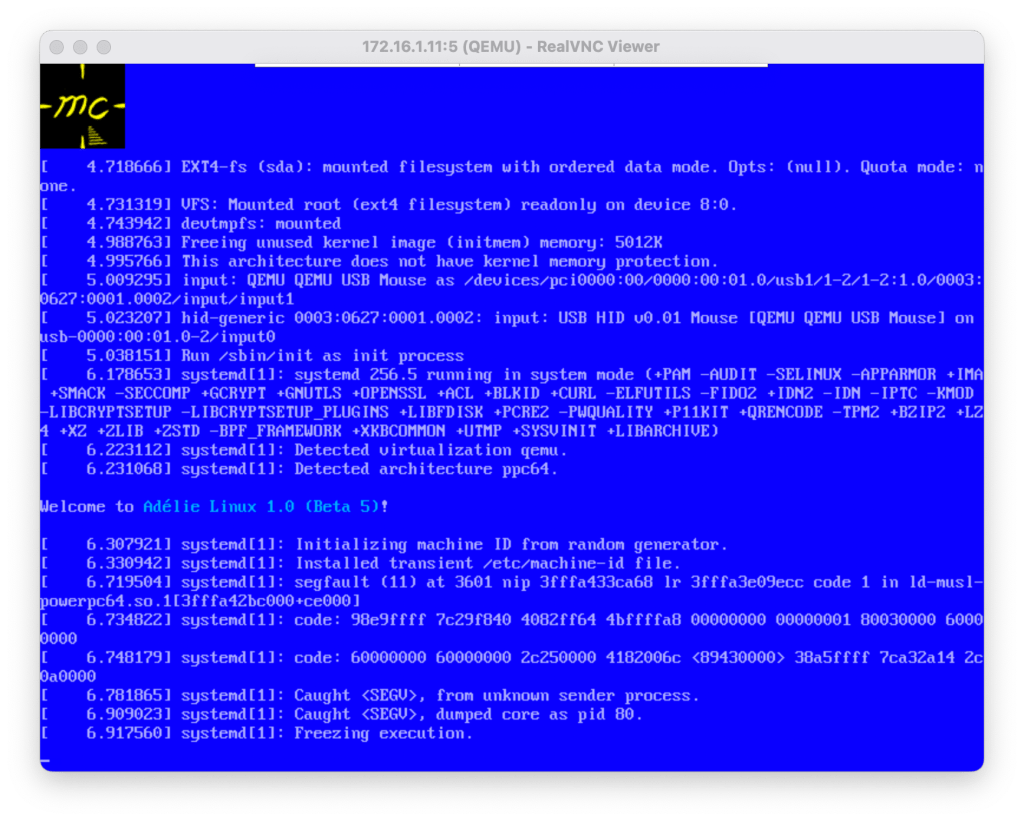
Welcome to an endian-swapped systemd core dump!

Debugging this was an experience in early systems debugging that I haven’t had in years. There’s a great summary on this methodology at Linus’s blog.

It turned out that I had disabled a test from build-util as I incorrectly assumed that was only used when debugging in the build root. Since I did not want to spend time digging around how it manually parses ELF files to find their RPATH entries for a feature we are unlikely to use, I stubbed that functionality out entirely. We can always fix it later.

Recreating the disk image and booting it up, I was greeted by an Adélie “rescue” environment booted by systemd. It was frankly bizarre, but also really cool.

The first time systemd ever booted an Adélie Linux system.

From walking to flying

Next, I built test packages on the Skylake builder we are using for x86_64 development. I have a 2012 MacBook Pro that I keep around for testing various experiments, and this felt like a good system for the ultimate experiment. The goal: swapping init systems with a single command.

It turns out that D-Bus and PolicyKit require systemd support to be enabled or disabled at build-time. There is no way to build them in a way that allows them to operate on both types of init system. This is an area I would like to work on more in the future.

I wrote package recipes for both that are built against systemd and “replace” the non-systemd versions. I also marked them to install_if the system wanted systemd.

Next up were some more configuration and dependency fixes. I found out via this experiment that some of the Adélie system packages do not place their pkg-config files in the proper place. I also decided that if I’m already testing this far, I’d use networkd to bring up the laptop in question.

I ran the fateful command apk del openrc; apk add systemd and rebooted. To my surprise, it all worked! The system booted up perfectly with systemd. The oddest sight was my utmps units running:

systemd running s6-ipcserver. The irony is not lost on me.

Still needed: polish…

While the system works really well, and boots in 1/3rd the time of OpenRC on the same system, it isn’t ready for prime time just yet.

Rebooting from a KDE session causes the compositor to freeze. I can reboot manually from a command line, or even from a Konsole inside the session, but not using Plasma’s built-in power buttons. This may be a PolicyKit issue – I haven’t debugged it properly yet.

There aren’t any service unit files written or packaged yet, other than OpenSSH and utmps. We are working with our sponsor on an effort to add -systemd split packages to any of the packages with -openrc splits. We should be able to rely on upstream units where present, and lean on Gentoo and Fedora’s systemd experts to have good base files to reference when needed. I’ve already landed support for this in abuild.

…and You!

This project could not have happened without the generous sponsors of Wilcox Technologies Inc (WTI) making it possible, nor without the generous sponsors of Adélie Linux keeping the distro running. Please consider supporting both Adélie Linux and WTI if you have the means. Together, we are creating the future of Linux systems – a future where users have the choice and freedom to use the tooling they desire.

If you want to help test this new system out, please reach out to me on IRC (awilfox on Interlinked or Libera), or the Adéliegram Telegram channel. It will be a little while before a public beta will be available, as more review and discussion with other projects is needed. We are working with systemd, musl, and other projects to make this as smooth as possible. We want to ensure that what we provide for testing is up to our highest standards of quality.

Experiences with building a Gentoo virtualisation host

As part of my work to set up infrastructure for a few projects that I hope to launch with some mates in the coming months, I needed to set up a KVM virthost using Gentoo. I decided to write up the process for FOSS Friday! This setup was performed on a Hetzner AMD server running the latest musl stage3, but glibc should be roughly the same.

Hetzner’s AMD offerings are some of the lowest cost dedicated servers with actual support and decent cross connects. All three of these factors are important to the projects that will be using this server.

Gentoo was chosen so that packages could be built with the exact configuration required. There are no extraneous dependencies that can cause vulnerabilities without even being needed or utilised by the actual workload.

The goal is for the host and guest VMs to share the same on-disk kernel. This way, the kernel is only built and updated once. All VMs will automatically boot into the new kernel when the host is rebooted into the new kernel. As such, the guests do not need a /boot or GRUB at all.

Configuring the Host

I decided to have the host and guests share virtually all of their Portage configurations, though I have not set up a centralised Git repository for them to live in just yet. The CPU_FLAGS_X86 are straight from cpuid2cpuflags. USE is “-X -nls -vala verify-sig”, a conservative but useful global-USE for lightweight, hardened infra.

The base hardware additionally needed sys-kernel/linux-firmware for AMD microcode and TCP offloading. Right now, I’m using package.accept_keywords to accept the ~amd64-keyworded version 20240115-r3. It has a significant performance improvement over 20240115 as I tweaked which firmware files are installed using savedconfig.

For package.use, the base settings I find most useful include:

# prefer lighter
app-alternatives/bc -gnu gh
app-alternatives/cpio -gnu libarchive

# trim the fat, what we don’t need on a server
dev-python/pygobject -cairo
net-firewall/ebtables -perl
net-libs/glib-networking -gnome
net-libs/libsoup -brotli
net-misc/netifrc -dhcp
sys-boot/grub -fonts -themes

# eliminate circular dep
dev-libs/libsodium -verify-sig

# would pull CMake into the graph
net-misc/curl -http2

# Required USE for libvirt / virt-install
app-emulation/libvirt lvm
app-emulation/libvirt-glib introspection
net-dns/dnsmasq script
net-libs/gnutls pkcs11 tools
sys-fs/lvm2 lvm
sys-libs/libosinfo introspection

I then did a full world rebuild, followed by emerge -av eix vim sysklogd chrony libvirt virt-install.

Host-side Networking

I created a bridge interface for the guests to use, which will be a private network segment with no access to the outside world. They will still have access to the host itself, which can run a Portage rsync mirror and binpkg/distfiles host as well.

I did the configuration this way because these VMs will contain sensitive data including login information, and I wanted to be extra-paranoid about network traffic going in to them. It’s probably better to use libvirt’s NAT if possible for your use case.

I added the following stanza to my /etc/conf.d/net:

bridge_kvmbr0=""
config_kvmbr0="172.16.11.1/24"

This added an empty bridge interface, and set the guest network subnet as 172.16.11.0/24. The host will use .1. To be extra fancy, you could configure a private DNS server to listen on that IP which would allow guests to resolve each other and communicate via hostname.

Host-side Kernel Configuration

I’m using gentoo-kernel, so there wasn’t any actual Kconfig to be done, but there is the matter of setting up the “hassle-free” automatic update system that I described in the introduction.

What I did was to symlink /boot/vmlinuz-current and /boot/initramfs-current to the present version. We can set the guests to boot that, and simply update the symlinks when the kernel itself is updated.

Configuring the Guests

I used a full-disk LVM volume group on the Hetzner server’s second attached disk for guest storage. I created an LV for each guest machine, and then formatted the LV with XFS. Since the VMs don’t need a boot loader there is no reason to have a partition table at all. You can use your file system of choice; I used XFS for performance and consistency.

# lvcreate -n keycloak -L 40G hostvg
Logical volume "keycloak" created
# mkfs.xfs /dev/hostvg/keycloak
[...]
# mount /dev/hostvg/keycloak /opt
# curl [stage 3 tarball] | tar -C /opt -xJf -
[Downloading and extracting the tarball]
# cd /opt
# mount -R /dev dev
# mount -t proc none proc
# mount -t sysfs none sys
# chroot /opt

We are now able to configure the guest environment as desired. Since there is no outbound network access, if you want network time you will need to run a network time server on the host. I personally tend to trust virtio’s RTC system as it rarely loses sync in my experience. With the present frequency of kernel and low-level system updates, it isn’t likely that any of these systems will have long enough uptimes to have tiny amounts of drift matter anyway.

We configure the guest-side networking to use the subnet we defined in the host bridge. For instance, on this VM I could use config_eth0="172.16.11.2/24". There is no reason to set routes_eth0 because the host system is not going to route packets out for it.

Setting up the Guest

Now it is time to run virt-install for the guest and boot it up. Make sure your SSH keys are installed and the chroot is unmounted first!

# virt-install --boot kernel=/boot/vmlinuz-current,initrd=/boot/initramfs-current,cmdline='console=tty0 console=ttyS0 ro root=/dev/vda net.ifnames=0' --disk /dev/hostvg/keycloak -n auth01 -r 8192 --vcpus=2 --cpuset=10-11 --cpu host --import --osinfo gentoo -w bridge=kvmbr0,mac=52:54:00:04:04:03 --graphics none --autostart

Let’s describe some of the fancier of these options. For a full description of the options used here and additional ones you can try, see the refreshingly coherent man page.

--boot kernel=…,initrd=…,cmdline=…
This sets up the guest to boot from the host kernel, as discussed previously.

--import
This tells virt-instal that we have already installed an OS to the disk provided, so it doesn’t need to perform any installation procedures. We’re “importing” an existing drive into libvirt.

-w bridge=kvmbr0,mac=52:54:00:…
This configures networking to use the bridge we set up previously. Note that the MAC for each guest must be unique, and for KVM VMs it must start with 52:54:00.

Enjoy!

This article showed the overview of how I’ve configured a Gentoo machine to serve as a virthost with a dedicated private LAN segment for guests and a way to have those guests share the same kernel as the host. We also looked at a way to “cheat” on storage by using an actual file system as the attached disk.

In the next set of articles, I plan to review:

  • Setting up WireGuard on the host to have pain-free access to the private LAN segment from my workstation for administration purposes
  • Leveraging the power of Gentoo overlays and profiles to have a consistent configuration for an entire fleet of servers
  • Sharing /var/db/repos and /var/cache/distfiles from the host to each guest, so there is only one copy – saving disk space, bandwidth, and time

Until then, happy hacking!

Compiling XIBs with CMake without Xcode

I’ve been enjoying using the JetBrains IDE CLion to do some refactoring and improvements to the Auctions code base. However, when I tried to build the Mac app bundle with it, the app failed to launch:

2022-07-30 19:54:15.117 Auctions[80371:16543044] Unable to load nib file: Auctions, exiting

The XIB files were definitely part of the CMake project. I later learned that CMake does not automatically add XIB compilation targets to a project. It relies on the Xcode generator to do that.

I found a long-archived documentation page from CMake on the Kitware GitLab that described a method to build NIB files from XIBs, and have modified it to make it simpler for Auctions.

You can see the change in the commit diff, but I’ll include the snippet here for posterity.

First, you define an array with the XIB file names with no suffix. For instance, I’ve done set(COCOA_UI_XIBS AXAccountsWindow AXSignInWindow Auctions) for the three XIB files presently in the codebase.

Then we have the loop to build them:

find_program(IBTOOL ibtool REQUIRED)
foreach(XIBFILE ${COCOA_UI_XIBS})
add_custom_command(TARGET Auctions POST_BUILD
COMMAND ${IBTOOL} --compile ${CMAKE_CURRENT_BINARY_DIR}/Auctions.app/Contents/Resources/${XIBFILE}.nib ${CMAKE_CURRENT_SOURCE_DIR}/${XIBFILE}.xib
COMMENT "Compiling NIB file ${XIBFILE}.nib")
endforeach()

Now it starts correctly and works properly when built from within CLion. This was surprisingly difficult to debug and fix, so I hope this post can help others avoid the hours of dead ends that I endured.

Until next time, Happy Hacking!

Daily-driving a Mac, one year later

It has been about a year since I published Really leaving the Linux desktop behind. This marks the first year I’ve used Mac OS as my primary computing environment since 2014. Now, I want to summarise my thoughts and feelings on using the Apple ecosystem as my primary platform – good and bad.

The Amazing

Universal Clipboard

Universal Clipboard has dramatically simplified my blog workflow. Typically, all of my articles are drafted and composed on my iPad Pro, as WordPress offers a great native app. This allows me to avoid using a browser. As I write this article, I am copying the links out of Safari on my Mac. They immediately show up in the pasteboard of the iPad.

KDE Connect does offer a Clipboard plugin, but it only supports plain text at this time. Apple’s implementation allows you to copy rich text, photos, files, and more.

Something else I would really like to note is that these features will work on High Sierra and later. It is transparent to the user no matter what version of the OS they are running. This somewhat alleviates the issue of newer OS versions having newer device requirements.

Safari Tab Groups

Safari 15 introduced the concept of Tab Groups, which is something I have been missing a lot since Firefox killed off extensions and replaced them with a severely limited alternative. Tab Groups simply allow you to categorise groups of tabs into cohesive sets. You can almost consider it a “focus window” where a logical set of tabs live.

The best part is that Safari’s Tab Groups sync between iCloud devices, which means I can use, add to, and manipulate tab groups on my tablet and phone as well. The replacement extension I used for Firefox had most of the features I enjoyed, but it doesn’t sync between devices using Firefox Sync, which meant I could really only browse the Web in this powerful way on my main desktop (then, my Talos II).

Having tab groups that sync between devices has allowed me to bring order to my previously chaotic Web browsing habits, allowing me to focus better and waste less time being distracted.

AirPlay

I love having the ability to AirPlay my screen directly to a TV. As far as I am aware, it is not possible on Linux to share your entire display to a smart TV without complicated command-line invocations that change regularly.

I used this to show my grandmother family photos while she was recovering from a health challenge. We use this monthly for budget planning in our household – just share Excel to the TV and we can see and discuss where the money is going this month.

There is no reason that this couldn’t be implemented on Linux, but off the top of my head I can think of a few challenges: the TV may have a different DPI than the computer screen (which has always been challenging for Linux windowing systems and toolkits), compressing the video using a libre codec while providing good picture quality and low bandwidth usage, and the general sorry state of wireless networking in Linux (which is due to the chipmakers, I know).

Apple Maps

Having a Maps app on my computer that I can use to view place details, satellite imagery, landmark information, and plan routes is a very powerful tool. I use this regularly to find places to shop local, and to plan weekend excursions to parks and attractions.

The closest thing I found on Linux was Marble. While I did enjoy the fact that Marble integrated so well with OSM, the views were always slightly grainy and off. Zoom and pan needed work and I could never understand the code well enough to contribute a fix.

You can still boot Linux on them

The Asahi Linux project has done an amazing job on building a boot loader for the M1 that should allow a whole host of alternative systems working. This includes not just Linux but also the BSDs, and perhaps even illumos when they bring up ARM64 support.

I remember when the M1 came out, everyone thought the firmware would be locked down and prevent non-Mac OS systems from running at all. It turns out that not only did this not happen, but you can actually sign your own kernels and have Trusted Boot using your own compiled Linux. This may end up making the M1 more libre-friendly than x86 systems.

Misc

  • Apps like Things really demonstrate the power of the Mac platform and what is on offer. You could probably make something as nice and integrated as Things on Linux, but for someone as busy as me, it is nice to use what is already there.
  • I feel much more in control of notifications on the Mac platform than I did on Linux with libnotify and Plasma. Notifications can be handled per-app, not just per-notification in the app itself. “Focus modes” (DnD) sync with my other devices like my phone and tablet. I can set repeating schedules (or one-offs) with profiles that allow some apps through but not others.
  • Older devices really are still supported. Even if you can’t boot Big Sur or Monterey on them, which is a big list if you are willing to play with a patching system, most of the niceties I’ve written about work back to High Sierra.

The drawbacks

The only real drawback that I’ve found in this year is that since the Mac isn’t a fully libre open-source system, I can’t fix the few bugs that I’ve run into.

I have not felt “trapped” or “helpless” or at all like I am living in a walled garden. Terminal is still there, unsigned apps can still be run with a simple context-click, and AppleScript (and now Shortcuts) is available to automate workflows.

I still believe that libre software ideals are correct and the goal of having a libre operating environment is a good one. However, I also believe that it was perhaps naive of me to believe that such a thing can truly exist in the way I hoped it could. The people who develop libre operating environments have different priorities.

And when you are spending your days using technology instead of making technology, the libre software ideals genuinely do become more of a theoretical than something in your face. This can be good, or bad, depending on your viewpoint.

At the end of the day, my goal in life is to make a difference, and also have a bit of fun. I want a system that is out of my way and lets me focus on that. For me, in 2022, that system is a Mac.

A final word on cost

Far too many people are priced out of the Apple ecosystem. I understand that part of the high cost of Apple products are to subsidise the R&D of making all these things work so well. However, they also have pretty high profit margins beyond their R&D expenditures.

I wish that Apple would lower their price, even a little, so that this amazing technology that works so well could be in the hands of more people.

Everyone on Earth deserves technology that is easy to use and lets them have a fun, happy life. That was my goal when I started the Adélie Linux project, and I only wish that more open source projects would do the same. Until then, I will continue doing my part to make the world a little bit better from the keyboard of a Mac.