The Retro Lab: Introduction

Welcome to my latest series of articles, The Retro Lab, where I will be detailing my excursions into the art and hobby of retrocomputing.

This article will serve as a general overview of what I hope to accomplish, and a bit about my background and why this will be fun for me 🙂 If you just want to see the meat of this, skip to the section “And now, in the present”.

My history with computers

When I was very young, my family had a 386 running DOS and Windows 3.1. The only thing I cared about were the games, of course. I don’t remember a lot from this era, because I was so young.

When we were with my grandpa, I loved to play on his XT clone. It was a Leading Edge Model D with 20MB disk running DOS. I inherited this computer when he passed and it is still in my closet. I treasure it. Some of the games it had were a text adventure game called “CIA” and Wheel of Fortune. The real magic for me, though, was in the BASIC interpreter. It was amazing to type in some commands and see this big huge loud complex machine do what I tell it! This is what hooked me on programming and is why I chose the field I did.

The next computer we had was a Canon StarWriter Pro 5000. I’m not sure what hardware it has – and it’s also in my closet, so a careful tear down may be a future article! – but I know it ran GEOS. I loved to write little comedy skits and song lyrics as a child, and it was cool to have all of them on a single 3.5″ floppy disk instead of taking all the paper in the house.

The real life changing moment, however, came on February 22, 1997. It was the day we brought home The Pentium. What a beast of a computer: 133 MHz, 24 MB RAM, and an 8 speed CD drive! It was a Compaq Presario 4712, and it came with Encarta 97, Compton’s Interactive Encyclopaedia, The Yukon Trail, Magic Carpet, PGA Tour ’96, but most of all: 15 free hours of America Online.

AOL was amazing to a second grader. They had Nickelodeon online! You could download little sound clips from Nick and Nick at Nite shows. They had games like Slingo (still one of my all-time favourite takes on slot machines, 20+ years later). And they had a graphical portal to Gopher/WAIS. The local school district had uploaded text files full of fun activities for us children on their Gopher server.

That computer was also where I first used Telnet to a computer running Solaris. A few friends and I used talk on it to have our own small chat rooms. My aunt ran an IRC channel and we talked on mIRC. We ended up with a webcam and talked with family using NetMeeting. Yahoo Messenger, ICQ, Infoseek… so many things.

Programming and desires

Enough with the ‘net reminiscing, at least for now 🙂

Something else important to mention is that my grandpa also was an Important Person at a facility, and one of the things he did was computer purchasing. He had catalogues from Compaq, IBM, and various other vendors in his house for that reason. I loved flipping through them and looking at all the cool stuff.

Something I always wanted back then was my own server. It seemed so cool. I was especially attracted to the ProLiants and AlphaServers in the Compaq catalogue. Windows NT and Tru64 looked so cool when I looked them up online.

The other thing that was very attractive back then were the Power Macintosh computers. My Mum was a digital artist back then. The Quadra was a nice system but didn’t compare to what I saw the Power Macs could do!

For my birthday in 1998, I received Visual Basic as a gift. It really cemented my desire to be a programmer. This was such an exciting time and part of the VB6 software was a one year subscription to the MSDN Library. From that library I learned about all the different servers one could run, all the different types of NT, the different programming languages of Visual Studio…

And now, in the present

In the past few years, as I am able and as opportunities arise, I have amassed quite a collection of hardware that I want to set up and enjoy:

A Compaq Armada e500 laptop. This is a Pentium III from the year 2000 and is likely the newest system I want to have in my Retro Lab. It runs Adélie right now; I’ll likely remove the hard drive and install another to run period-accurate software. I will likely run Windows NT 4 or 2000.

A beige Power Macintosh G3 with the Bordeaux personality card. I will be inserting a 10 GB disk and installing Mac OS 8.6 on it. This will run all the classic Mac software that I have collected over the years. It will be one of the main focuses of the Lab.

A few AlphaServers. Most are earmarked for Adélie so I can’t really use them in the Lab, but there is a single DS10L that was set aside for my personal use. I’ll likely install NT 4 on this one, but I need to investigate further on the hardware.

A Sun Ultra 60, Netra T1, and Ultra 10. These are all from ’98-’99 and will make great Solaris systems, to relive the glory days and experiment more with what was my first real Unix. I would like to run CDE again and possibly do some Java tinkering with these. It would be very fun to run a Retro Lab network off of the AlphaServer and Netra.

A Power Macintosh 7100/80AV. More fun Mac stuff awaits on this computer, though I’m not sure exactly what I will do with it yet.

A Compaq LTE 5150. This is actually my original laptop from high school, ca. 2004. I’d like restore it to its former glory and use it for Windows 3.1 and early 95 software. It can also run OS/2. The screen probably won’t do well for most games, but I do have the docking bay to connect it to an external monitor…

An SGI Indy. This will need an SCSI2SD adaptor to reach its full potential since the hard disk died many years ago. I would love to dual boot IRIX and a BSD.

A Dell System 316LT. There are a few older DOS games I have that would run much better under a CPU of this speed. It needs some love; I seem to recall it had an issue booting up the last time I had it out. I could also try and run GEOS.

A Compaq Presario 4850. This is, to my knowledge, the oldest original computer I have that still fully functions. We purchased it on my Mum’s birthday, 1998, for her graphic design software. This, along with the Beige G3, will likely be the centrepiece of my Lab. I plan on running either Windows 95 or 98 on it, and also various other OSes of the era: BeOS, OpenStep, maybe early Linux. I know that the Rage Pro functions in high res in Win3.1 and OS/2 from prior hackings. It’s also the first computer I used to tinkered with XFree86 modelines. It has a factory original Hitachi DVD drive.

Don’t forget the accessories!

Oh yes, I have some great period hardware for the tinkering as well:

HP ScanJet 5s SCSI scanner. Drivers for Windows, Macintosh, and IRIX, at least. I believe there is an attachment to scan photo negatives as well, but I can’t remember now.

Aiptek webcam. Yes, the original one from the NetMeetings of old that I talked about in my history section. Should be very easy to bring up under Windows. I am curious about Macintosh support.

HP CD Writer Plus 7200e. This is a parallel port, dual-speed CD writer and rewriter. One of the cool features I found on this back in the day is that if you send multimedia commands and have speakers connected to the external headphone jack, you can power off the computer and still listen to the CD until it finishes! I found this out one day when Win95 crashed while I was listening to Garbage’s Version 2.0.

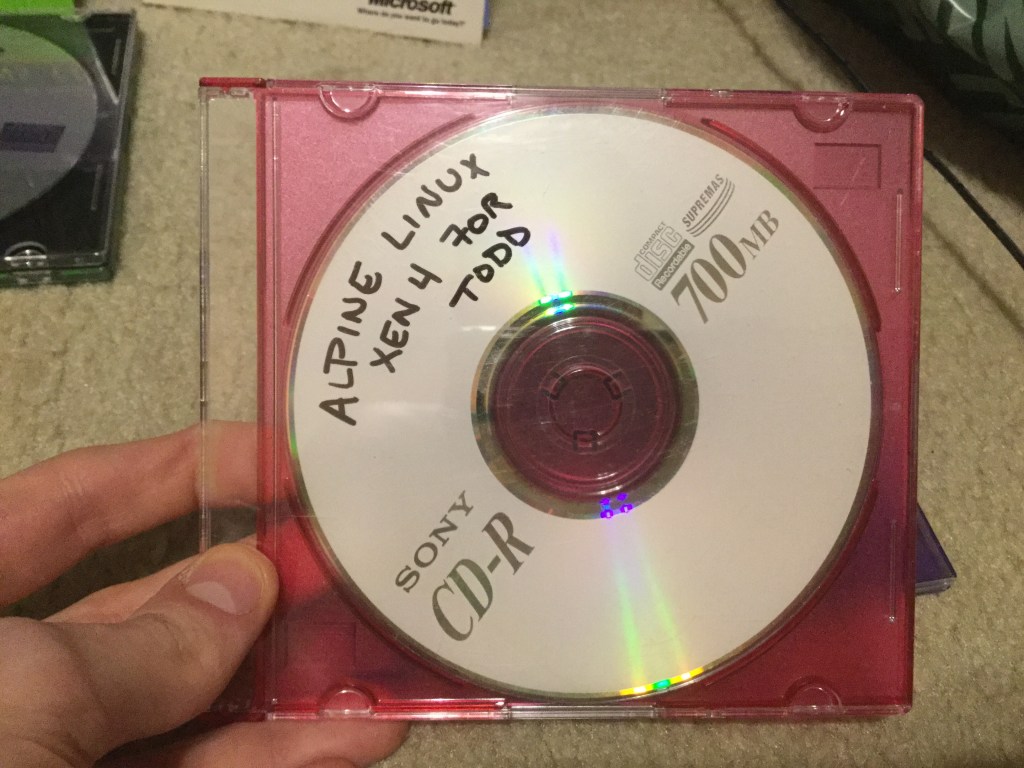
My MSDN Universal archive. In 2002 I found an MSDN Universal subscription at a flea market for 15 USD. I activated it and have all the CDs, and also sent a special request for them to send me the Archive CDs which included BackOffice 4.5 and a few other goodies.

Unfortunately my back and neck are not up to carrying a CRT. I have a flat panel from 2006, a 17″ ViewSonic, that seems to be very close in specification to what we could have had in 1998 for way too much money 😉 Hey, with everything else being so accurate, a little cheating on the monitor isn’t so bad!

In conclusion

This was a lot longer than I had originally anticipated, but it also covers a lot of ground. Over the coming weeks, I hope to bring up a few of these computers and document the processes. Until then, happy hacking!

Live from Adélie: Streaming Spotify on musl

Over the July 4th holiday weekend, I was working on a secret project. It was a resounding success and I can now announce to the world: Spotify runs on musl distributions!

This article will describe how I went about accomplishing this feat. If you just want to take Spotify for a test drive on your Adélie workstation or Void desktop, scroll to the “Instructions” heading.

Greetz

Thanks to these fine dwellers of IRC for helping make sense of the twisty mazes.

  • [[sroracle]]
  • Aerdan
  • cb
  • dalias
  • skarnet

gcompat 0.4.0: how very cash LC_MONETARY of you

The latest release version of gcompat did not get very far:

awilcox on laptop spotify % ./spotify
Segmentation fault (core dumped)

Inspecting the core file was minimally helpful:

Thread 1 "ld-musl-x86_64." received signal SIGSEGV, Segmentation fault.
0x0000000001d6ff60 in ?? ()
(gdb) bt
#0  0x0000000001d6ff60 in ?? ()
#1  0x00007fffffffd738 in ?? ()
#2  0x0000000001e94f13 in ?? ()
#3  0x00007fffffffd6d0 in ?? ()
#4  0x00007fffffffd738 in ?? ()
#5  0x0000000003e9d691 in ?? ()
#6  0x0000000003e9d698 in ?? ()
#7  0x0000000003e9d691 in ?? ()
#8  0x00007fffffffd738 in ?? ()
#9  0x00007fffffffdc40 in ?? ()
#10 0x0000000001ccd0f0 in ?? ()
#11 0x00007fffffffd7a0 in ?? ()
#12 0x0000000000000001 in ?? ()
#13 0x00007fffffffd720 in ?? ()
#14 0x0000000001e92e92 in ?? ()
#15 0x0000000003e9d691 in ?? ()
#16 0x0000000003e9d698 in ?? ()
#17 0x00007fffffffd738 in ?? ()
#18 0x00007fffffffd738 in ?? ()
#19 0x00007fffffffd760 in ?? ()
#20 0x0000000001e9dd51 in ?? ()
#21 0x00007fffffffdc40 in ?? ()
#22 0x0000000003e9b3e0 in ?? ()
#23 0x00007fffffffd7e8 in ?? ()
#24 0x00007fffffffd7b8 in ?? ()
#25 0x00007fffffffd7b8 in ?? ()
#26 0x00007fffffffd828 in ?? ()
#27 0x00007fffffffd810 in ?? ()
#28 0x0000000001e9df09 in ?? ()
#29 0x612f656d6f682f1a in ?? ()
#30 0x0000786f636c6977 in ?? ()
#31 0x0000000000000000 in ?? ()
(gdb) info registers
rax            0x54454e4f4d5f434c  6072345775086453580
rbx            0x53                83
rcx            0x53                83
rdx            0x2                 2
rsi            0x53                83
rdi            0x3e9b1a0           65647008
rbp            0x7fffffffd6f0      0x7fffffffd6f0
rsp            0x7fffffffd690      0x7fffffffd690
r8             0x0                 0
r9             0x0                 0
r10            0x1                 1
r11            0x7fffffffdb9c      140737488346012
r12            0x7fffffffd6b8      140737488344760
r13            0x7fffffffd6b0      140737488344752
r14            0x7fffffffd6a8      140737488344744
r15            0x7fffffffd6c0      140737488344768
rip            0x1d6ff60           0x1d6ff60
eflags         0x10202             [ IF RF ]
cs             0x33                51
ss             0x2b                43
ds             0x0                 0
es             0x0                 0
fs             0x0                 0
gs             0x0                 0

What are we trying to do? Looking at symbols present in the Spotify binary, this is actually part of the G++ runtime; specifically, std::ctype::do_tolower:

  1d6ff51:       48 8b 05 18 a8 12 02    mov    0x212a818(%rip),%rax        # 3e9a770 
  1d6ff58:       48 8b 40 70             mov    0x70(%rax),%rax
  1d6ff5c:       48 0f be cb             movsbq %bl,%rcx
=>1d6ff60:       8a 1c 88                mov    (%rax,%rcx,4),%bl
  1d6ff63:       89 d8                   mov    %ebx,%eax
  1d6ff65:       5b                      pop    %rbx
  1d6ff66:       c3                      retq

That rax value looks suspicious, and we can see if we translate it to ASCII that it is the little-endian representation of the string “LC_MONETARY”. We’re trying to reach 0x70 into a structure in %rax for a pointer value, but we’re getting a string instead.

It turns out that when libstdc++ is compiled on a glibc system, it will attempt to access the internal __ctype_* members in the locale_t of the current locale. musl’s locale_t is not ABI-compatible with glibc’s. In fact, it is only 48 bytes in length; 0x70 (or 112 bytes) is past the end of the locale object musl has provided it!

I implemented a stub locale module in gcompat, and… it tried to exec /proc/self/exe, which broke under the gcompat loader. This required me to write a patch interposing the execv* functions to catch this. And suddenly…

The lights that stop me turn to stone

Slight success! We have a Spotify window!

Spotify, but only a white screen

… but a blank white screen only. After some inspecting, I found that one of the many zygotes CEF was forking was segfaulting:

[158358.508029] ThreadPoolForeg[3230]: segfault at 0 ip 0000000000000000 sp 00007fe3203db448 error 14 in spotify[200000+1acd000]
[158365.067313] ThreadPoolForeg[3252]: segfault at 0 ip 0000000000000000 sp 00007f2d69c172e8 error 14 in spotify[200000+1acd000]
[158378.506832] ThreadPoolForeg[3312]: segfault at 0 ip 0000000000000000 sp 00007f52ed7c8448 error 14 in spotify[200000+1acd000]
[158383.654027] ThreadPoolForeg[3339]: segfault at 0 ip 0000000000000000 sp 00007fcb631eb2e8 error 14 in spotify[200000+1acd000]

I replaced libcef.so from the Spotify DEB package with a matched-version libcef.so from Spotify’s Open Source builds page. This allowed me to have more debugging symbols, and generating a core dump revealed:

Core was generated by `ld-linux-x86-64.so.2 --argv0 /usr/share/spotify/spotify --type=utility --field-'.
Program terminated with signal SIGSEGV, Segmentation fault.
#0  0x0000000000000000 in ?? ()
[Current thread is 1 (LWP 12774)]
(gdb) bt
#0  0x0000000000000000 in ?? ()
#1  0x00007f79a8a3d671 in sqlite3MallocSize () at ../../third_party/sqlite/amalgamation/sqlite3.c:26957
#2  mallocWithAlarm () at ../../third_party/sqlite/amalgamation/sqlite3.c:26891
#3  sqlite3Malloc () at ../../third_party/sqlite/amalgamation/sqlite3.c:26913
#4  0x00007f79a8aff232 in sqlite3MallocZero () at ../../third_party/sqlite/amalgamation/sqlite3.c:27118
#5  pthreadMutexAlloc () at ../../third_party/sqlite/amalgamation/sqlite3.c:25755
#6  0x00007f79a8a4e9b2 in sqlite3MutexAlloc () at ../../third_party/sqlite/amalgamation/sqlite3.c:25298
#7  chrome_sqlite3_initialize () at ../../third_party/sqlite/amalgamation/sqlite3.c:24906
#8  0x00007f79a8a350bd in EnsureSqliteInitialized () at ../../sql/initialization.cc:55
#9  0x00007f79a8a30eb2 in OpenInternal () at ../../sql/database.cc:1357
#10 0x00007f79a8a30dfa in Open () at ../../sql/database.cc:270
#11 0x00007f79a8fb8de6 in InitializeDatabase () at ../../net/extras/sqlite/sqlite_persistent_store_backend_base.cc:99
#12 0x00007f79a8fb9751 in LoadNelPoliciesAndNotifyInBackground () at ../../net/extras/sqlite/sqlite_persistent_reporting_and_nel_store.cc:1041
#13 0x00007f79a5abe25b in Invoke<void (leveldb_proto::ProtoDatabaseSelector::*)(base::OnceCallback), scoped_refptr, base::OnceCallback > () at ../../base/bind_internal.h:498
#14 MakeItSo<void (leveldb_proto::ProtoDatabaseSelector::*)(base::OnceCallback), scoped_refptr, base::OnceCallback > ()
    at ../../base/bind_internal.h:598
#15 RunImpl<void (leveldb_proto::ProtoDatabaseSelector::*)(base::OnceCallback), std::__1::tuple<scoped_refptr, base::OnceCallback >, 0, 1> () at ../../base/bind_internal.h:671
#16 RunOnce () at ../../base/bind_internal.h:640
#17 0x00007f79a7776fa0 in Run () at ../../base/callback.h:98
#18 RunTask () at ../../base/task/common/task_annotator.cc:142
#19 0x00007f79a7792862 in base::internal::TaskTracker::RunBlockShutdown(base::internal::Task*) () at ../../base/task/thread_pool/task_tracker.cc:743
#20 0x00007f79a7792062 in RunTask () at ../../base/task/thread_pool/task_tracker.cc:598
#21 0x00007f79a77d42fb in RunTask () at ../../base/task/thread_pool/task_tracker_posix.cc:23
#22 0x00007f79a7791a43 in RunAndPopNextTask () at ../../base/task/thread_pool/task_tracker.cc:450
#23 0x00007f79a7798386 in RunWorker () at ../../base/task/thread_pool/worker_thread.cc:321
#24 0x00007f79a77980f4 in base::internal::WorkerThread::RunPooledWorker() () at ../../base/task/thread_pool/worker_thread.cc:223
#25 0x00007f79a77d4a05 in ThreadFunc () at ../../base/threading/platform_thread_posix.cc:81
#26 0x00007f79ac9fe2dd in ?? ()
#27 0x00007f79aca799e8 in ?? ()
#28 0x00007f7998247ce0 in ?? ()
#29 0x0000000000000000 in ?? ()
(gdb) frame 1
#1  0x00007f79a8a3d671 in sqlite3MallocSize () at ../../third_party/sqlite/amalgamation/sqlite3.c:26957
26957     return sqlite3GlobalConfig.m.xSize(p);

Inspecting the SQLite3 code, I realised that it was somehow getting a nullptr for the malloc_usable_size pointer. Further inspection revealed that this was not exactly the case:

(gdb) disassemble 0x7f79a77d5520
Dump of assembler code for function malloc_usable_size():
   0x00007f79a77d5520 :     push   %rbp
   0x00007f79a77d5521 :     mov    %rsp,%rbp
   0x00007f79a77d5524 :     mov    %rdi,%rsi
   0x00007f79a77d5527 :     mov    0x484a76a(%rip),%rdi        # 0x7f79ac01fc98 
   0x00007f79a77d552e :    mov    0x28(%rdi),%rax
   0x00007f79a77d5532 :    xor    %edx,%edx
   0x00007f79a77d5534 :    pop    %rbp
   0x00007f79a77d5535 :    jmpq   *%rax
End of assembler dump.

Looking at how the Chromium allocator works internally, the issue is that RTLD_NEXT won’t work on libraries loaded before libcef. And looking at the output of ldd spotify revealed both libm and libdl before libcef; musl always redirects these to libc for glibc ABI compatibility.

Using PatchELF to remove these two DT_NEEDEDs from the binary yielded a surprising result…

Music makes the people come together

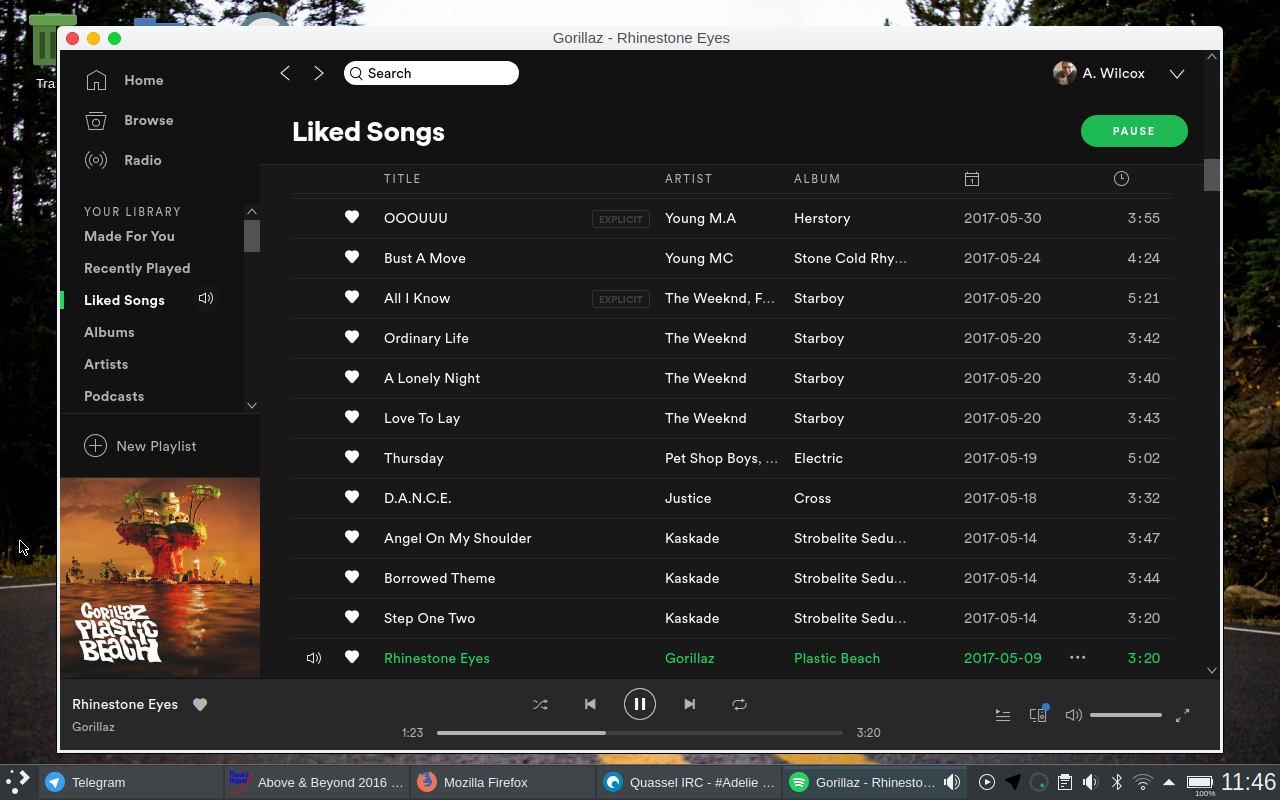
Spotify on Adélie Linux
Spotify, playing “Rhinestone Eyes” by Gorillaz, on my Adélie laptop

It works! All the features I tested work: Spotify Connect, which means I can control the laptop’s playback using the iOS and Apple Watch apps; radio playback; Bluetooth speaker support.

Instructions

You will need to download the official Spotify 64-bit DEB. I have not tested this on a 32-bit system yet, but I see no reason it won’t work. Once you have the DEB, extract the data.tar.xz file somewhere. Use PatchELF on the Spotify binary as so:

$ patchelf --remove-needed libm.so.6 usr/share/spotify/spotify
$ patchelf --remove-needed libdl.so.2 usr/share/spotify/spotify

Move the extracted usr/share/spotify directory to your system’s /usr/share directory. For better integration, I moved the /usr/share/spotify/spotify.desktop file to /usr/share/applications. Then move the usr/bin/spotify link to /usr/bin.

Ensure that you have the latest gcompat installed. As I write this, only Adélie has the newest version in the current repo. I’ll be submitting merge requests to the distros I know that ship gcompat this week to ensure everyone has a chance to play around with the new bits.

Have fun!


Do you like running Spotify on musl? Or do you just like reading about fun hacks? Consider donating to Adélie to keep the fun going!

Reckless Software Development Must End

On the 6th of November, 2019, I made a comment on Twitter:

Okay, so today’s news isn’t as dramatic as Uber killing a homeless woman by not programming in the fact that pedestrians might not use crosswalks, but it is based in the same mode of thought.

Today’s news is that the US state of Iowa has had issues with their election processes (processes that are a bit too complex for me to provide you an overview in this blog). The problem boils down to reckless abandon of software engineering principles.

As reported in the New York Times and The Verge, in addition to many other outlets, there were a number of failings in the development and deployment of this software package that would have been trivial to prevent.

My personal belief is that the following issues significantly contributed to the failure we have seen.

No test plan

There was no well-defined plan of testing.

The test plan should have covered testing of the back-end (server) portion of the software, including synthetic load testing. My test plan would have included a swarm of all 1600+ precincts reporting all possible data at the same time, using a pool of a few inexpensive systems running multi-connection clients.

The test plan should have also included testing of the deployment of the front-end (user facing) portion of the software. They should have asked at least a few of the precinct staffers to attempt to complete installation of the software.

Ideally, a member of the development team would be present for this, to note where users encounter hesitation or issues. However, we are far from an ideal world. My test plan would have included a simple Skype or FaceTime session with the poll workers, if face-to-face communication would have been prohibitive.

These sessions with real-world users can be used to further refine the installation process, and can inform what should be written in documentation to simplify and streamline the experience for the general user population. Then, users should be allowed to input mock test data into the software. This will allow the development team to see any issues with the input routines, and function as an additional real-world test for the back-end portion.

By “installation”, I mean the set up required after the software is installed. For instance, logging in with the unique PIN that reportedly controlled authentication. I am not including the installation of the app software onto the device, which should not have been an issue at all — and which is covered in the following section.

Lack of release engineering

Software must be released to be used.

It appears that the developers of this software either did not have the software finished before the Iowa caucus began (requiring them to on-board every user as a beta tester), or they did not intend to have a proper ‘release’ of the software at any time (meaning every user was intended to be a beta tester). I could write a full article on the sad state of software release engineering, but I digress.

The software was distributed to users via a testing system, used for providing pre-release or “beta” versions to testers. This is an essential system to use when you have a test plan like what I described above. This is, however, a bad idea to use for releasing software for production.

On Apple’s platform, distributing final releases via TestFlight or TestFairy can result in your organisation being permanently banned from accessing any Apple developer material. Not counting the legal (contract law) issues surrounding such a release, on Android this requires your users to enable what is called “side-loading”, or installing software from untrusted third-party repositories.

All of the Iowa caucus precinct workers using the Android OS now have mobile devices configured in a severely vulnerable way, and they have had sideloading normalised as something that could be legitimate. The importance of this cannot be understated. This is a large security risk, and I am already wondering in the back of my mind how this will affect these same workers if they are involved with the general election in November. The company responsible for telling them to configure their mobile devices in this manner may, and in my opinion should, be liable for any data loss or exploitation that happens to these people.

My release plan document would have involved clearly defined milestones, with allowances for what features would be okay to postpone for later releases. This could include post-Iowa caucus releases, if necessary — the Nevada Democratic Party intended to use this software for their 22nd February caucus. Release planning should include both planned dates and required dates. For example:

  • Alpha release for internal testing. Plan: 6 December. Must: 13 December.
  • Beta release, sent for wider external testing. Plan: 3 January. Must: 10 January.
  • Final release, sent to Apple and Google app stores. Plan: 13 January. Must: 20 January.
  • Iowa Caucus: 3 February (hard).

Such a release plan would have given the respective app stores at least two weeks to approve the app for distribution.

Alternatively, if the goal was to avoid deployment to the general app stores of the mobile platforms, they could have used “business-internal” deployment solutions. Apple offers the Apple Business Manager; Google offers Managed Google Play. Both of these services are included with their respective developer subscriptions, so there is no additional cost for the development organisation.

Lack of security processes

Authentication control is important in all software, but especially so in election software. This team demonstrated to me a lack of understanding of proper security processes by providing the PIN on the same sheet of paper that would be used on the night of the election for vote tallying.

I would have had the PIN sent to the precinct workers via either email, or using a separate sheet which they could have in their wallet. Ideally, initial log in and authentication would have taken place on the device before the release, with the credentials stored in the secure portion of device storage (Secure Enclave on iPhone, TrustZone on Android). However, even if this is not possible, it was still possible to provide the PIN to users in a more secure manner.

Apparent lack of clearly defined specification

I have a sneaking suspicion that the combination of these failings mirror the many other development organisations who refuse to apply the discipline of engineering to their software projects. They are encouraged by bad stewards of engineering to “Move Fast and Break Things”. They are encouraged by snake-oil peddlers of “process improvement” that formal specification and testing are unnecessary burdens. And this must change.

I’m not alone in this call. Even the Venture Capitalist section of Harvard Business Review admits that this development culture is irresponsible and outdated. Software developers and project managers must be willing to #Disrupt the current industry norm and be willing to Move Moderately and Fix Things.

Cascading failures (or, why I did nothing this weekend)

This is a fun one.

To set the scene and provide information in temporal order, my Talos and WD Black NVMe device have never “gotten along” well. Frequently, the device would fail to train for whatever reason. Calling reboot from a Petitboot shell with fast-reset enabled was enough to fix this, so I didn’t think all that much about it.

Late in the night Thursday (or early in the morning Friday, if you prefer), I was reading a few articles before I went to bed. At 01:36:13, an animal darted in front of a car about two miles away, causing the car to crash into a power pole. This caused a serious power surge as the lines came down on to each other (and the car’s frame).

My office is was protected by an APC BX1500G combination battery backup (SPS, not UPS) and surge protection unit. The power surge was severe enough that the unit failed. The lights, the Power Mac G5, and the Talos in my office went immediately dark as the alarm went off making a continuous noise while “F04” and “See Manual” flashed on the display. This code means “Clamp Short”, and means that the varistor that is supposed to arrest surges had become permanently ‘stuck’ in arrest mode.

My first priority was to ensure the integrity of my hardware, so I dug out a spare APC SPS and put the battery from the now-failed one in it. I powered on my Talos and while it seemed to IPL fine, lspci in Petitboot did not show my NVMe device as present. Looking in Hostboot, it now wasn’t even failing to train — the slot may as well have been unoccupied. I tried both a fast-reset and a full system power cycle to no avail.

The next day, I attempted to swap slots, thinking the PCIe slot that the NVMe device was connected to may have been damaged by the power surge. I swapped the NVMe and the sound card. The sound card worked in the slot formerly occupied by the NVMe, but the NVMe still wouldn’t come up in the slot formerly occupied by the sound card. Now came the worrying part: did the M.2 to PCIe adaptor fail, or did the NVMe media itself fail?

I went to two of our local computer stores to buy some parts. I decided that since I was already going to need to do a full disk swap (even if I could recover the data off the NVMe media), it would make sense to add SATA media as well. I had a 256 GB SATA SSD laying around that was supposed to be put in my Xeon until it failed. I found an “open box” Seagate 1 TB HDD for 30 USD at DISC Surplus Computers in Sand Springs. And I found a new 4-port Marvell chipset based SATA controller for 34 USD at Wholesale Computer Supply in Tulsa. I also had a 3 port USB 3.0 controller card sitting on a shelf since the slot it was meant to go in was occupied by a 2-slot Radeon that was used for big endian amdgpu.ko porting. I went ahead and shelved that Radeon (and the big endian porting effort, for now) and used the CPU 1 slot for SATA and the CPU 2 slot for the USB card.

I then turned my attention to recovering the NVMe media. I brought out my old Intel Reference Platform board, a DP43TF with developer firmware, and put the NVMe adaptor card with media in to it. Unfortunately, the DP43TF only has one PCIe slot larger than x1, and it’s the x16 typically used for a GPU. Since NVMe is x4, I had to find a PCI GPU. I pulled a GeForce 8400GS out of one of our Pentium 4 test boxes and attempted to boot the Adélie 1.0-BETA4 live CD.

Our Live CD does not support the JMicron PATA controller that the DP43TF’s DVD drive was connected to. I ended up using a USB optical media, but I also could have used SATA optical media. The CD I was attempting to use was scratched, and it refused to finish booting (the scratched section appears to have contained OpenRC). I had to find a computer capable of burning media, which was no small task since most newer computers don’t support writing optical media and most of my computers have marginal USB support at best.

One of our community members reminded me that the PowerBook G4 has a SuperDrive, which I used to burn a fresh x86_64 BETA4 CD. Finally booted, I noticed the NVMe was present but throwing occasional controller reset errors. I’m not sure if this was due to media degradation or the fact it was a Gen3 NVMe in a Gen1 PCIe slot. At any rate, I used dd to make a full clone of the NVMe to the 1 TB Seagate disk, and then put that in the Talos. A gracious member of the Adélie Linux community donated the funds needed to replace the NVMe with a Samsung 970 EVO Pro of the same size.

Yesterday I copied the data off the Seagate 1 TB to the new Samsung NVMe. Everything is working quite well, and the Samsung is much faster than the Western Digital; 712 MB/s uncached write vs 303 MB/s on the WD. The additional space on the Seagate can be used for further testing, and for possible expansion of Adélie to more platforms — I may post more on that later. 🙂

This was a very interesting experience for me. It’s been many years since I’ve seen a cascade of failures like this: car accident breaks APC SPS, which breaks NVMe marginally, which shows an issue booting our live CD on a specific computer. It also gave me a reason to re-catalogue a lot of the hardware I have on hand for testing purposes, and to know what needs fixing and replacing. And most importantly, it made me realise I need to perform weekly backups instead of semi-annual backups.

I want to especially thank the members of the Adélie Linux community that helped with this process, not only financially but with techniques and ideas to make this go well. My workstation is better than ever, and now I can get even more done for libre software. You rock!